Two seconds hands can agree and still be wrong.
That is the first distinction to keep in mind when looking at the F.P. Journe Chronomètre à Résonance. Agreement between oscillators is a remarkable physical behavior. Accuracy against a time reference is a different result. Understanding the relationship between them makes the watch more interesting, because it replaces a mysterious word with questions we can actually investigate.
The central idea is that two oscillators can influence one another and settle into a coordinated pattern. In this watch, the oscillators are balance wheels and their springs. The name Résonance points toward that interaction. It is the beginning of the explanation, not the conclusion.
What needs to agree
An oscillator repeats a motion. Its frequency describes how often it completes a cycle. Its phase describes where it is within that cycle at a given moment.
Two oscillators can run at the same frequency without reaching each point in their motion together. In a synchronized system, their relative timing can settle into a stable relationship. That relationship might be in phase or in opposition, depending on the system. “Synchronized” therefore does not always mean “moving in the same direction at the same instant.”
The broader physical vocabulary needs similar care. Resonance often describes an especially strong response to periodic driving near a system's natural frequency. Synchronization concerns the coordination of interacting oscillators. The concepts are related, but the words do not describe precisely the same thing. In discussions of these watches, “resonance” commonly carries the more specific story of coupled oscillators coming into step. [1, 2, 5]
There must be an interaction. Simply placing two independent timekeepers beside each other does not guarantee that they will coordinate. Their construction, adjustment, and means of coupling all matter.
A historical observation that remains instructive
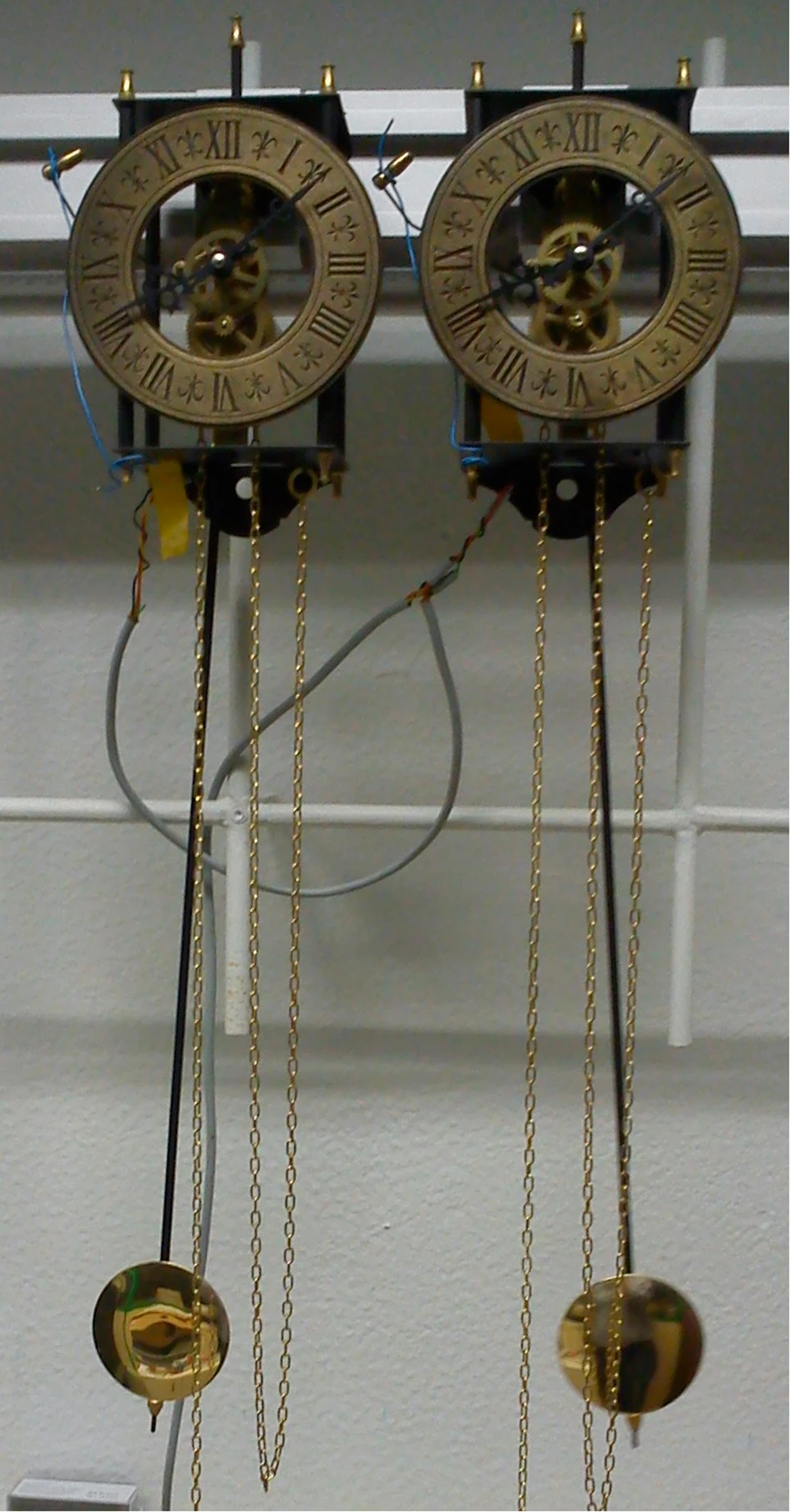
In 1665, Christiaan Huygens reported pendulum clocks whose motion settled into opposition while they shared a support. Modern researchers have revisited this kind of behavior with experimental clocks and mathematical models. [2]
The common support is a crucial part of the story. Something that seems like background furniture can participate in the dynamics of the system. Tiny movements can provide a path by which one oscillator affects another.
The lesson for a reader is to ask where an interaction travels. Through a support? A dedicated coupling element? Another physical route? A useful explanation must name a possible route and show that it matters under the relevant conditions.
A pendulum demonstration does not, by itself, validate a wristwatch. The oscillators, supports, dimensions, and operating environment differ. It illustrates a principle. Establishing the behavior of a particular watch requires evidence about that watch.
This distinction keeps an appealing historical connection from becoming an all-purpose certificate. We can appreciate the lineage of an idea while still asking what a modern construction accomplishes.
Separate the jobs inside the Journe
Journe introduced the Résonance wristwatch in 2000. The substantial redesign presented in 2020 uses one mainspring barrel, a differential that distributes power to two gear trains, and a one-second remontoir for each train. These are the manufacturer's descriptions of the architecture. [3]
A remontoir is a small intermediate energy store, replenished at intervals, intended to make the supply reaching the escapement more uniform. Its job concerns power delivery. Synchronization concerns the relationship between the oscillators. Putting both ideas inside the same watch does not make them the same mechanism.
The distinction is particularly useful when following a diagram. First trace where the energy comes from and how it reaches the escapements. Then ask how the oscillators interact. A shared source of power is not, on its own, proof of synchronization.
The calibre 1520 specification lists 42 hours of total autonomy and an effective running interval of 28 hours, with a stated tolerance, associated with its constant-force operation. Those numbers describe different intervals and should not be casually exchanged. [4]
They also offer a more general lesson. A mechanism can continue to run after it leaves a particular operating regime. “The watch is still ticking” and “this feature is still operating as described” may require different evidence.
The brand describes its resonance approach as operating without a direct mechanical transmission between the oscillators. [4] That wording must not be understood as an absence of all physical interaction. Synchronization requires coupling. The shared mechanical structure offers a route for interaction, as the clock experiments help us understand, but the documentation cited here does not quantify that route in this wristwatch. Establishing its contribution requires measurements under actual operating conditions.
Agreement is not accuracy
Consider a hypothetical pair of timekeepers that both gain ten seconds a day. Their agreement is excellent. Their agreement with a reliable time reference is not.
The example is deliberately simple because it exposes a common leap in reasoning. Two readouts remaining close together can tell us something about their relative rates. It cannot, without an external comparison, tell us whether their common rate is correct.
There is experimental support for keeping the concepts separate. A 2016 study of coupled monumental pendulum clocks observed synchronization accompanied by a decrease in their common frequency: the clocks became slow. That result concerns the researchers' apparatus, not a test of a Journe wristwatch. It demonstrates why synchronization alone is insufficient evidence of accuracy. [2]
The worthwhile engineering question is more specific. Under which conditions does a coupled system improve stability, resist a disturbance, or recover its relationship? Those outcomes require definitions and measurements. None should be assumed merely because the word “resonance” appears on a dial.
This leaves plenty to admire. Creating a working system that makes subtle interactions useful is a substantial design challenge. Explaining its limits treats the work seriously rather than diminishing it.
What an attentive observer can ask
When examining a Résonance, identify the generation first. Instructions and architecture should come from the documentation for the actual reference. The two displays provide a visible invitation to compare behavior, but watching them briefly is not a performance test.
A useful investigation would record elapsed time against a dependable reference, state of wind, position, and environmental conditions. It would distinguish each display's error from the difference between the displays. A claim about improvement would also need an appropriate comparison, not merely an impressive-looking observation.
At a gathering, most of us will have neither the equipment nor the time for that investigation. We can still ask a better question: what is being shown here, and what would we need to measure next?
The fascination of the Résonance survives that question. Its two displays invite us to think about timekeeping as a relationship between systems, not just a movement running in isolation. The most satisfying explanation allows the wonder to remain while making the uncertainty precise.
Discussion: If two displays stayed together for a day, what additional evidence would you want before calling the watch more accurate?
Sources & further reading
- Rui Dilão — On the problem of synchronization of identical dynamical systems, 2008 · Reviewed 2026-10-01
- Peña Ramirez and colleagues — The sympathy of two pendulum clocks, 2016 · Reviewed 2026-10-01
- F.P. Journe — Résonance twentieth anniversary release, April 28 2020 · Reviewed 2026-10-01
- F.P. Journe — Chronomètre à Résonance calibre 1520 · Reviewed 2026-10-01
- OpenStax — University Physics Volume 1 section 15.6 Forced Oscillations · Reviewed 2026-10-01
Continue the conversation
Share a question with the society