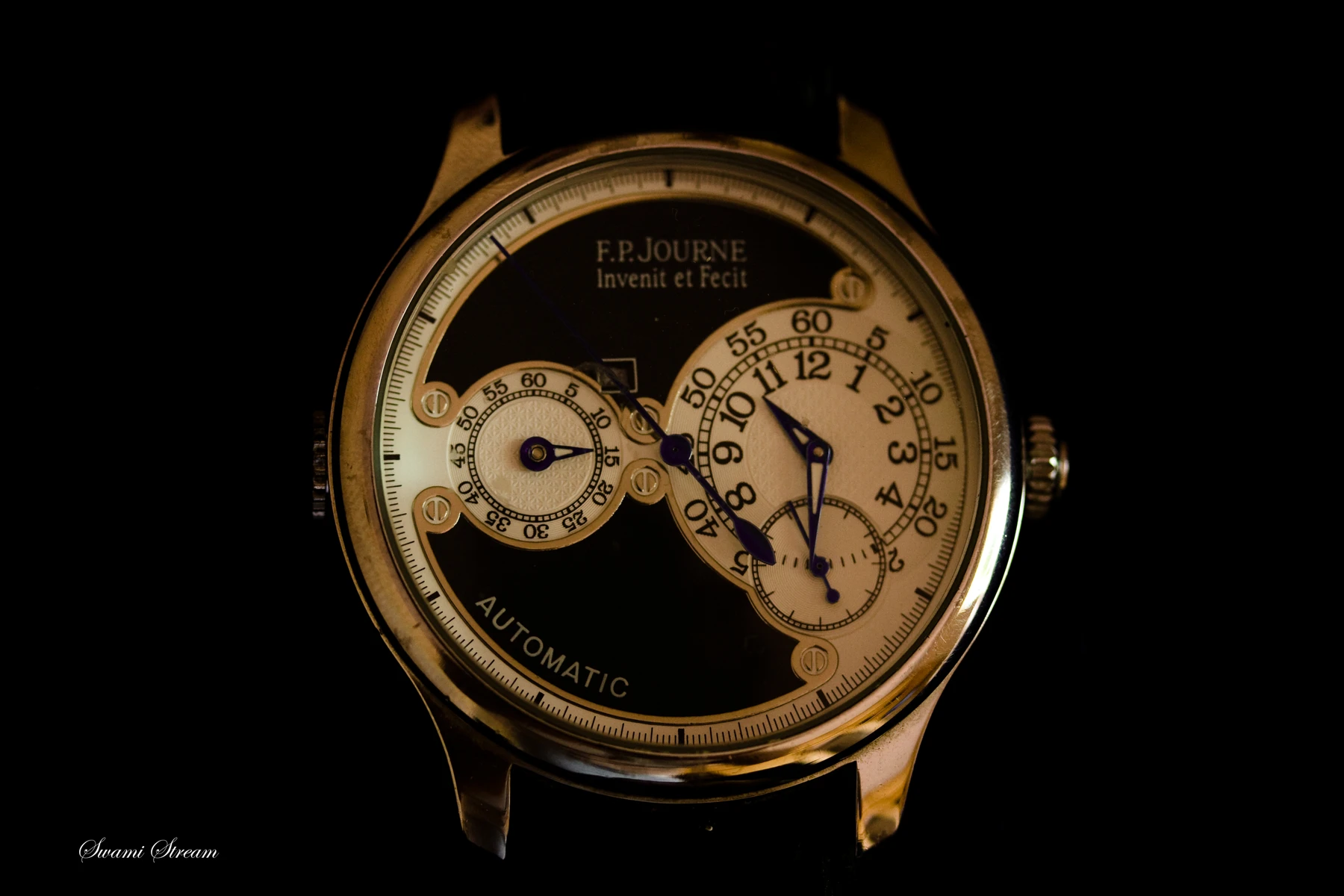
A watchmaker repairing an old movement faces a peculiar form of conversation. The person who designed it is absent. The explanation survives in the arrangement of the parts: why a wheel sits there, why a bridge takes that shape, why one solution was preferred to another. To restore the mechanism intelligently, the repairer has to recover something of the reasoning that made it.
That is a useful place to begin with François-Paul Journe. Before the recognizable dial, before the collecting categories and auction attention, there was a young watchmaker learning from objects that other people had made. His story asks a question larger than watchmaking: how does close study of the past become a source of original work?
An education in other people's decisions
Journe was born in Marseille in 1957. The Académie Horlogère des Créateurs Indépendants, or AHCI, records his membership from 1988. Those dates locate him in a living craft community; he did not arrive fully formed with a brand launch. [1]
His company's biography describes training that began in Marseille at fourteen, continued in Paris, and led to work with his uncle, an antique watch and clock restorer. It also recounts his early ambition to build a tourbillon pocket watch. This is the manufacturer's account of its founder, so its celebratory tone should be recognized. The central fact is more useful than the legend: his formation involved the examination and repair of historical mechanisms. [2]
Restoration is an unusually demanding education in design because the object gets a vote. A proposed explanation must account for what the mechanism actually does. An attractive theory that leaves a watch unable to run has a conspicuous weakness.
It also teaches a distinction that matters to collectors. An old solution can be intelligent even when it is inconvenient to manufacture today. A modern solution can be efficient without being especially interesting to study. Understanding either one requires asking what problem its maker was trying to solve, with what tools and under what constraints.
In a 2017 interview with A Collected Man, Journe recalled that antique mechanisms resisted a single standardized procedure. Different constructions required him to understand each watch on its own terms. He also described his interest in the decisions of earlier makers, including Breguet and Janvier. This is retrospective testimony, valuable for understanding his perspective rather than a transcript of his youth. [3]
The distinction matters. We do not need to imagine a dramatic workshop scene to see what such work could teach: the ability to recognize a familiar principle inside an unfamiliar arrangement.
When a name becomes a collection
The company's historical account dates Journe's first tourbillon wristwatch prototype to 1991 and the presentation of his signed collection to 1999. The familiar inscription Invenit et Fecit means “invented and made.” [4]
Those are different milestones. A prototype establishes that a particular object has been made. A collection requires a repeatable proposition: watches that other people can order, receive, maintain, and understand as related works. The distance between the two is filled with decisions that rarely appear on a dial.
For a maker, repetition poses an artistic problem as well as a production problem. Which details constitute the identity of the work? Which can change? How much variation can a collection accommodate before the name becomes its only common feature?
This is where Journe becomes especially interesting. His work invites the reader to connect a visual language with a mechanical agenda. The dial offers the first impression; the arrangement behind it gives that impression something to be about. A collector need not admire every result to recognize the ambition of making the two answer to one another.
Nor should the signature erase everyone else. A founder can establish a direction while relying on the skill and judgment of the people who turn it into finished objects. Calling a watch the work of Journe is a statement about authorship. It is not evidence that one pair of hands manufactured every component.
Recognition and what it tells us
Institutional recognition provides firmer landmarks than the adjective “legendary.” The Musée international d'horlogerie lists Journe as the 1994 Gaïa laureate for Craftsmanship and Creation. The Grand Prix d'Horlogerie de Genève records Aiguille d'Or awards for the Tourbillon Souverain in 2004, Sonnerie Souveraine in 2006, and Centigraphe Souverain in 2008. [5, 6]
Awards tell us that particular juries found particular work exceptional. They do not settle whether a watch will fit your wrist, suit your life, or justify its cost to you. Their proper role in this story is to show that the work attracted serious recognition across different creations.
That breadth changes how we should approach the brand. Starting with its most familiar blue dial alone can make the rest seem like variations around a single success. Starting with the maker's questions leaves room for watches that pursue very different problems.
There is a pleasure in following an individual's recurring concerns through a body of work. A new object becomes more interesting when it changes our understanding of an earlier one. Biography helps when it sharpens that attention. It becomes a distraction when every design decision is treated as proof of genius.
The company beyond the individual
An independent watchmaker who succeeds eventually confronts a question no escapement can answer: how should the enterprise outlast its founder?
In a 2018 interview with SJX, Journe discussed Chanel's investment in the company in terms of succession and continuity. That interview records his stated intentions at the time; it should not be mistaken for a current ownership report. [7]
The question remains instructive. Creative independence includes the ability to make choices, but an enduring workshop also needs people, training, organization, and resources. To admire the individual while ignoring those conditions is to misunderstand what it takes to keep an individual vision alive.
For the reader beginning this series, the most useful result of knowing Journe's journey is a better set of questions. What historical idea is being reconsidered? What has changed in its application? What does the visible design help us understand? Where does the achievement lie, and where does our own preference begin?
A watchmaker's name becomes meaningful when it helps us see the watch more clearly. In Journe's case, the route back through restoration gives that name particular substance. The past supplied problems worth thinking about. Making something recognizably his own required deciding which of them deserved another answer.
Discussion: When a contemporary watch revisits an old mechanical idea, what makes the result feel original to you?
Sources & further reading
- AHCI — François-Paul Journe · Reviewed 2026-10-01
- F.P. Journe — Institutional press dossier 2020 · Reviewed 2026-10-01
- A Collected Man — From the bench François-Paul Journe, July 7 2017 · Reviewed 2026-10-01
- F.P. Journe — Invenit et Fecit · Reviewed 2026-10-01
- Musée international d’horlogerie — Gaïa press kit 2020 · Reviewed 2026-10-01
- GPHG — Winners 2001 to 2023 · Reviewed 2026-10-01
- SJX — Interview with François-Paul Journe, November 20 2018 · Reviewed 2026-10-01
Continue the conversation
Share a question with the society