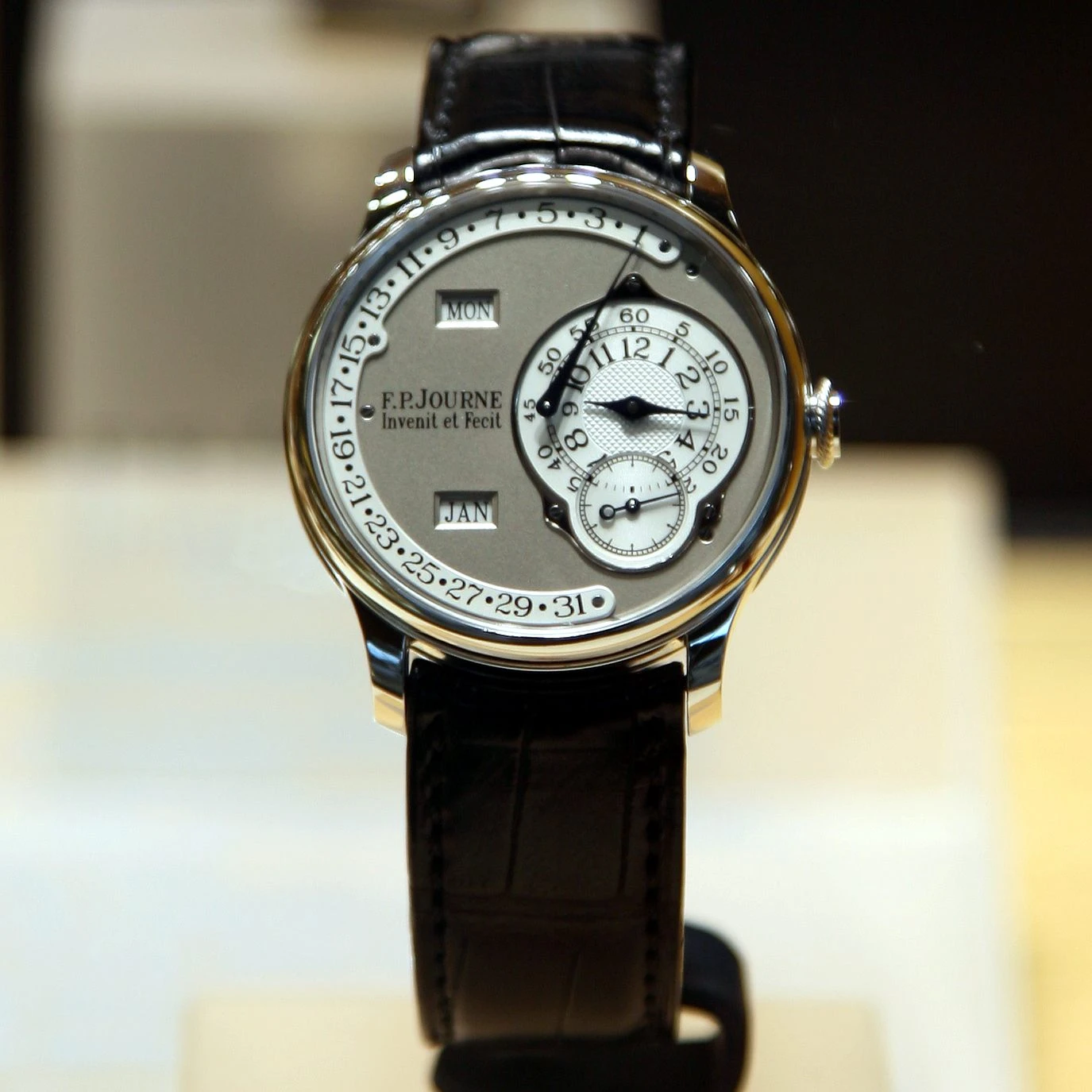
Before you pick up the watch, ask its owner how they would like you to handle it.
That small courtesy is a better beginning than an attempt to demonstrate expertise. It establishes permission, gives the owner a chance to explain anything particular about the example, and turns an encounter with an expensive object into a conversation between people.
Your first F.P. Journe need not become a test. You do not have to identify the movement at a glance, recognize every dial variation, or reach a verdict before handing it back. The useful aim is simpler: notice enough to come away with one observation that is your own.
Begin with the whole watch
Use a clear, protected surface and follow the owner's preferred handover. Keep the watch supported, with the strap or bracelet controlled, rather than letting it hang from an open clasp. If you are unsure about the fastening, ask for help. This is handling advice, not a claim about any particular model's construction.
Before reaching for a loupe, look at the watch from an ordinary reading distance. Where does your eye go? Can you find the time without searching? What relationship do you see between the hands, numerals, and remaining space?
Those are substantial questions. Magnification is excellent at making small details conspicuous; it can also make the overall design disappear from your attention. A dial has to work as a whole before it rewards scrutiny one square millimeter at a time.
On a Chronomètre Bleu, you might begin with the placement of the seconds. On a Résonance, you might consider how two time displays share the face. The correct observation is the one you can actually support by looking at the example in front of you. [1, 2]
Avoid treating recognition as a race. A thoughtful question usually contributes more than a hurried reference number.
Let the light ask a second question
With the owner's permission, change the viewing angle gently while keeping the watch secure. Notice what becomes easier to see and what becomes harder. Look at the hands against the dial, then at the transitions between case surfaces.
The point is to understand the object across ordinary conditions. A dial that looks striking from one angle may become quieter from another. A polished surface can describe a curve through its reflections. These are observations to make, not effects to assume in advance.
If you have permission to try it on, let the owner help with the fastening and assess the fit without altering anything. Notice where the case sits, how the strap holds it, and whether you are conscious of its mass. Your wrist is the relevant measuring instrument for comfort; somebody else's wrist cannot cast the deciding vote.
Write down the distinction between what you observed and what you preferred. “The hand became harder for me to see at that angle” is more informative than “bad dial.” “I enjoyed the weight” is more honest than declaring heaviness a universal mark of quality.
Turn it over with a question in mind
Ask before turning the watch over, and keep it above the protected surface. Through a display back, begin with the movement's layout. Which parts move? Which structures hold other parts in place? How much of the mechanism is visible?
Then choose one detail to study more closely. It might be an edge, a screw head, a change in surface treatment, or the shape of a bridge. Naming exactly what you see is useful even if you do not yet know the technical term.
For the Chronomètre Bleu, the manufacturer's specifications identify an 18-karat rose-gold movement. That shorthand refers to major structural components; it should not become a claim that every internal part is gold. [1]
It is similarly unwise to turn an attractive surface into a verdict on performance. Appearance, manufacture, regulation, and service condition are connected aspects of a watch, but one does not automatically certify the others.
A loupe can help you see. It cannot tell you the whole history of an object. Leave room for questions that require records, measurement, or a qualified examination.
Let the owner operate the controls
Do not wind, set, reset, or activate anything without asking. Even if you know another Journe well, a different reference may have different operating instructions.
The company's care guidance directs owners to the manual corresponding to their model and warns against forcing a manual-winding crown. The Chronomètre Bleu manual, for example, contains a specific recommendation against moving its hands anticlockwise. This is exactly why casual rules learned from other watches should not substitute for the correct instructions. [3, 4]
Ask for a demonstration instead. What does the owner normally do when putting the watch on? Which functions do they use? Is there a habit they had to learn? These questions connect engineering to daily experience without requiring you to operate an unfamiliar mechanism.
If the watch is a Résonance, watching its two displays is a good beginning to a technical conversation. Their apparent agreement during a short encounter does not establish accuracy against a time reference. Curiosity benefits from knowing what a demonstration can show and what it cannot.
If admiration becomes a purchase question
Handling a watch socially is not an authentication or condition assessment. If you later consider buying an example, the questions become more specific.
Ask for the exact reference, available provenance and service records, and a clear account of any work performed. If a seller describes a watch as “serviced,” ask who did the work, when, and what the documentation says was included. The word is more useful with a record attached.
F.P. Journe's service information describes diagnosis before an estimate and directs authenticity inquiries to a boutique. Consult the manufacturer about the actual example and the work available for it; do not assume an older model can receive every cosmetic treatment you might want. [5]
For a first encounter, however, there is no need to turn admiration into a transaction. A watch can reward attention without becoming a shopping objective. Learning what you like is worthwhile even when the result is a more informed decision to enjoy it at a distance.
Before returning it, give the owner one specific observation and one sincere question. Perhaps you noticed the way the seconds display changes the dial's balance. Perhaps the movement's layout surprised you. That is enough to begin a worthwhile exchange.
The best thing to carry away is a more attentive eye. It will remain useful when the next watch placed in your hand is entirely different, and it costs nothing to use.
Discussion: What is the first detail you would want to examine in a Journe, and what would you ask its owner about living with it?
Sources & further reading
- F.P. Journe — Chronomètre Bleu calibre 1304 · Reviewed 2026-10-01
- F.P. Journe — Chronomètre à Résonance calibre 1520 · Reviewed 2026-10-01
- F.P. Journe — Care instructions · Reviewed 2026-10-01
- F.P. Journe — Chronomètre Bleu owner’s manual · Reviewed 2026-10-01
- F.P. Journe — Service · Reviewed 2026-10-01
Continue the conversation
Share a question with the society