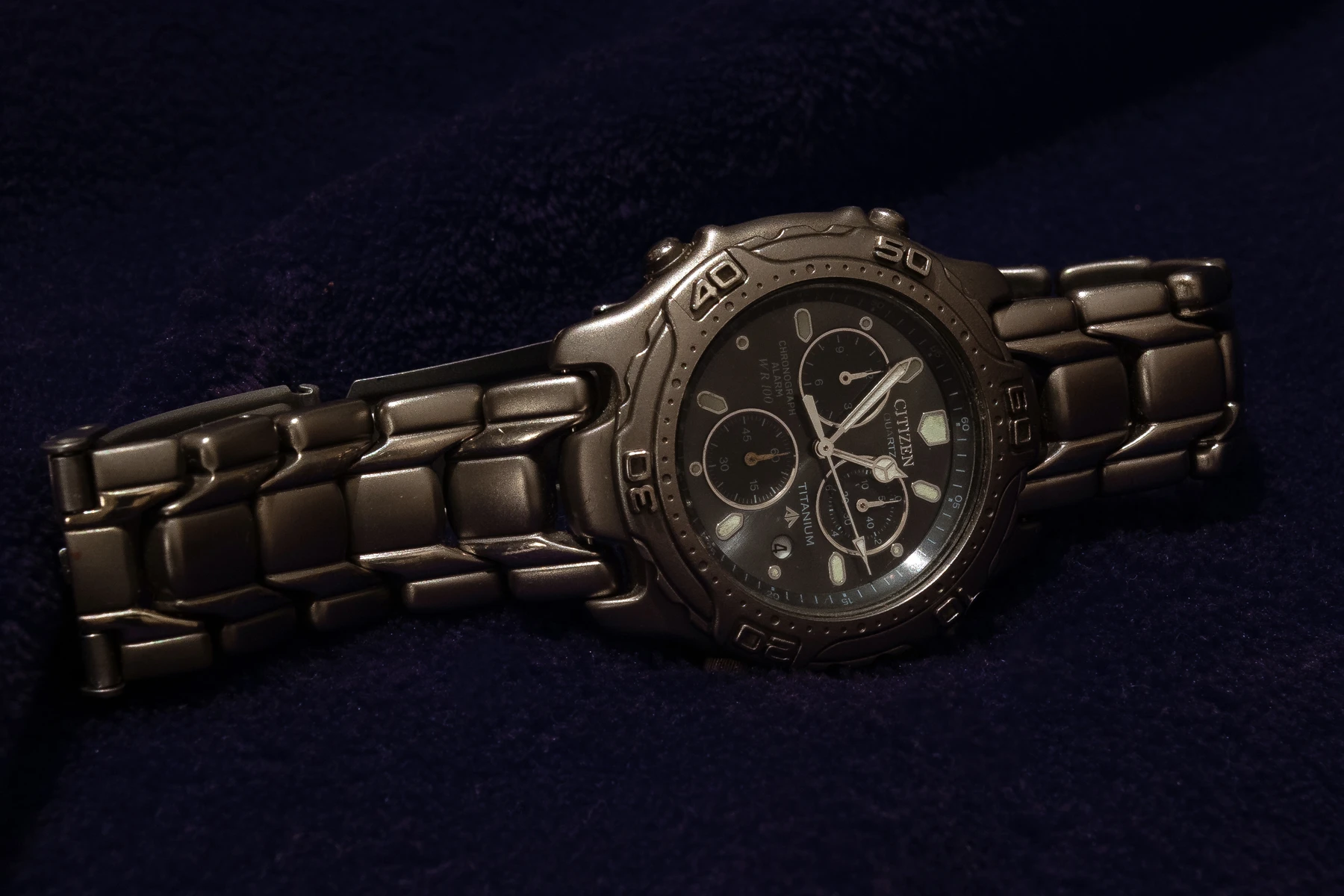
Pick up a watch you expect to feel substantial and find it unusually light. For a moment, the impression and the object disagree. That small surprise is an opening into materials science.
Collectors sometimes treat weight as shorthand for quality. Yet heft cannot tell us how carefully a movement was assembled, how well a bracelet fits, or whether a case was finished with patience. It tells us something narrower, and still worth understanding: how much material is present, which materials were chosen, and where the designer put them.
Begin with density
Density describes mass per unit of volume. TIMET lists 4.42 grams per cubic centimetre for its Ti-6Al-4V titanium alloy, identified as ASTM Grade 5. Outokumpu lists 8.0 grams per cubic centimetre for Supra 316L/4404 stainless steel; its table uses the equivalent unit kilograms per cubic decimetre. [1, 2]
Consider two imaginary solid cubes, each exactly one cubic centimetre. Using those listed densities, the titanium cube would have about 45 percent less mass. This is a calculation about equal volumes of two specified materials. It is not a measurement of two watches.
A finished watch includes a movement, crystal, seals, dial, hands and fastening components. Case thickness, bracelet construction and the number of fitted links also change the result. To find the difference between two actual watches, compare their complete specifications or weigh the identified examples in the same configuration. A material label alone cannot supply that answer.
Read the grade as a specification
The word titanium covers more than one material. TIMET identifies Grade 2 as commercially pure titanium; the designation allows controlled amounts of other elements. Grade 5 is an alloy with aluminium and vanadium. [1, 3]
The numbers identify different specifications. They are not scores for craftsmanship. Ask which grade is used, in which components, and whether the manufacturer identifies a surface treatment. Those questions reveal more than treating the higher number as a universal recommendation.
Look closely at the surface
The surface deserves its own line of inquiry. A material’s resistance to permanent deformation, its resistance to indentation, and the appearance of marks in a particular finish are related questions with different answers. The familiar word “strong” is too broad to settle them all.
CITIZEN offers a useful example. It describes Super Titanium as titanium treated with its proprietary Duratect technology. The company explains that Duratect variants can coat a surface, harden it, or combine both approaches. [4] That is a manufacturer’s description of its process, rather than an independent comparison of every titanium watch.
When someone predicts how a titanium case will wear, ask about the particular grade, finish and treatment. A broad claim that all titanium behaves alike leaves out much of the watchmaking. Look at the actual example under ordinary light; ask how its maker recommends caring for and, when appropriate, refinishing that exact model.
Let your wrist finish the comparison
The engineering question becomes a personal one when the watch is fastened. Does it sit where you want it? Does its clasp press against your wrist? Can the bracelet be adjusted comfortably? Does the watch move around as you move your hand?
Try each candidate with a suitable fit and give yourself a few quiet minutes. Describe what you notice before deciding what it means. “This feels lighter” is an observation. “This must be less well made” is a conclusion that needs other evidence.
At a gathering, that distinction can improve the conversation. Ask an owner what living with the watch is like, which details they appreciate and what they would change. A specification can explain part of the experience; the owner can describe the rest.
Titanium offers a way to make particular design choices. Whether those choices suit you is something to discover on your own wrist.
When you try a watch, what do you notice first: its weight, its fit, or the way the light moves across its case?
Sources & further reading
- [1] TIMET · TIMETAL 6-4 data sheet, page 1 · Reviewed 2026-09-29
- [2] Outokumpu · Supra range data sheet, page 8, Table 7 · Reviewed 2026-09-29
- [3] TIMET · TIMETAL 50A data sheet, page 1 · Reviewed 2026-09-29
- [4] CITIZEN · Super Titanium technology · Reviewed 2026-09-29
Continue the conversation
Share a question with the society