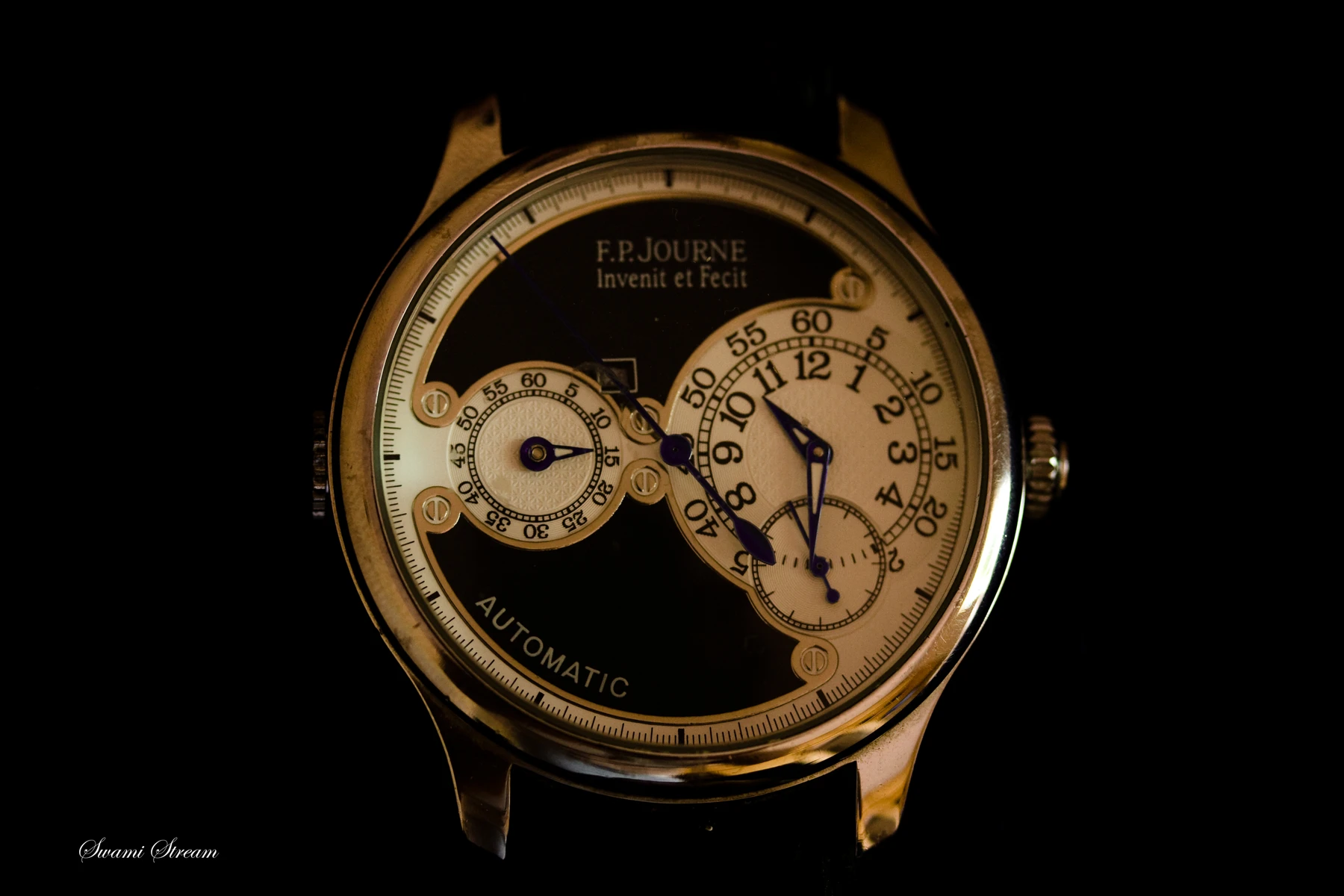
Take the name off the dial for a moment. What would still persuade you to spend time with the watch?
It is a useful question for any celebrated maker, and an especially useful one for F.P. Journe. A reputation can bring us to an object. Once we arrive, it can also get in the way. We may find ourselves admiring the difficulty of obtaining something before we have worked out what we admire about the thing itself.
Journe offers a better starting point: a body of work with a discernible point of view. That helps explain the possibility of deep attachment. It does not establish a universal theory of collectors, whose motives are as varied as their collections. The aim here is to identify what the watches offer an attentive reader, then separate that from the excitement surrounding ownership.
The pleasure of recognizing an author
In collecting, recognition can be more satisfying than novelty. The pleasure lies in noticing that different objects share a way of thinking, even when they do different jobs.
Consider the contrast between the Chronomètre Bleu's relatively spare time display and the paired displays of the Chronomètre à Résonance. One asks for attention through a concentrated composition; the other makes a mechanical relationship part of the face of the watch. Both are productive starting points for looking at how an idea becomes visible. [1, 2]
There is a difference between being able to identify a logo and being able to describe a design. The first is recognition of a name. The second involves proportions, placement, rhythm, and the relationship between what a watch shows and what it does.
Collectors can become devoted when that second kind of recognition continues to reward them. A feature that initially seemed peculiar begins to feel necessary. Another, once overlooked, becomes the reason the design holds together. Learning changes the object without altering it.
This is an argument for spending time with a watch before deciding what its reputation means. It is also permission to disagree. A strongly individual design will not suit everyone, and it would be strange if it did.
Something remains to be understood
Journe's appeal also benefits from the distance between seeing and understanding. A mechanism may be visible through the back, but visibility is not the same as explanation.
A reader can begin with the shape of a bridge, move to the function of the parts it supports, and then ask why the movement was arranged that way. The questions become more precise. That progression can be a form of enjoyment in its own right, independent of any wish to purchase.
The Résonance makes the point particularly well. The name invites a physical explanation, yet saying that two oscillators can synchronize leaves important questions open. Through what interaction? Under what conditions? What benefit is proposed? What evidence would demonstrate it? Our fourth installment will work through those questions rather than treating a technical word as a compliment.
An interesting watch gives curiosity somewhere to go. That is a more durable source of enthusiasm than a specification whose only apparent function is to sound impressive.
This does not make complexity a requirement. A simple display can prompt demanding questions about legibility and proportion. Technical ingenuity and visual restraint are different achievements; neither becomes more valuable merely by being difficult to explain.
The electromechanical élégante offers another useful complication to the brand's image. Its hands can stop during inactivity while the electronics continue keeping time, then return to the correct indication when it resumes operation. [4] For anyone tempted to define Journe entirely through mechanical tradition, that is a productive surprise. It suggests that following a maker's work can require revising the category we initially put it in. Admiration becomes more rewarding when it leaves room to learn something unexpected.
Independence has several meanings
The word “independent” can describe ownership, creative authority, scale, or a collector's idea of a maker's character. These meanings overlap, but they are not interchangeable.
In his 2017 interview with A Collected Man, Journe framed independence in terms of freedom of choice. That is his definition, and it offers a useful way to read his work. It does not eliminate the practical demands of operating a company. [3]
For a collector, the attraction may lie in following decisions that feel connected to a particular mind. There is someone whose judgment can be considered, challenged, and recognized across different watches. The relationship resembles an interest in an author's books more than an obligation to approve everything bearing the name.
The analogy has limits. Watches have to function, endure handling, and be maintained. A compelling creator's story cannot substitute for those obligations. Nor does the story entitle a brand to less scrutiny. If anything, a claim to a distinctive approach gives us more reason to ask exactly what that approach accomplishes.
Devotion becomes more interesting when it can survive a specific criticism. A collector who can explain a watch's compromise often understands it better than one who insists it has none.
The social life of close looking
Imagine two people discussing the same watch. One knows its auction history. The other has noticed how the seconds display changes the balance of the dial. Both observations may be worth hearing. Only one requires a conversation about money.
That distinction matters for a watch society. The most expensive object in the room need not produce the best conversation. Someone who owns no Journe at all can ask the question that makes an owner see theirs differently.
Knowledge becomes generous when it gives another person something to notice. It becomes a barrier when its purpose is to establish who belongs. A learning series should favor the former, including when the subject is a maker associated with serious collecting.
There is also a practical test for enthusiasm: can we describe a watch's interest without mentioning its availability? If the answer is yes, the object has begun to emerge from its market story. If the answer is no, we may have discovered that the pursuit itself is what attracts us. That is a different kind of interest, and it is worth recognizing honestly.
Giving admiration room to be specific
Scarcity can intensify desire. It cannot tell us whether a dial is resolved, whether a mechanism addresses a worthwhile problem, or whether we would enjoy living with the watch. Those judgments require other evidence.
Likewise, price cannot perform all the jobs we assign it. A transaction records what someone paid under particular circumstances. It is an inadequate substitute for describing craft, condition, provenance, or personal attachment. This series will not use market movement as a shortcut to significance.
The case for spending time with F.P. Journe is therefore quite straightforward: the work supports several kinds of attention. We can study a maker's formation, examine a particular design, investigate a mechanical claim, or consider how an object feels to use. Each approach can refine the others.
Devotion is most persuasive when it makes someone more observant. The collector who notices more, asks better questions, and welcomes another person's response gives the rest of us a reason to join the conversation. That is the kind of enthusiasm worth encouraging, whether the watch belongs to them or remains a photograph on the page.
Discussion: Which detail in a watch you admire would still matter to you if nobody else recognized its name?
Sources & further reading
- F.P. Journe — Chronomètre Bleu calibre 1304 · Reviewed 2026-10-01
- F.P. Journe — Chronomètre à Résonance calibre 1520 · Reviewed 2026-10-01
- A Collected Man — From the bench François-Paul Journe, July 7 2017 · Reviewed 2026-10-01
- F.P. Journe — élégante 48 mm Titanium calibre 1210 · Reviewed 2026-10-01
Continue the conversation
Share a question with the society